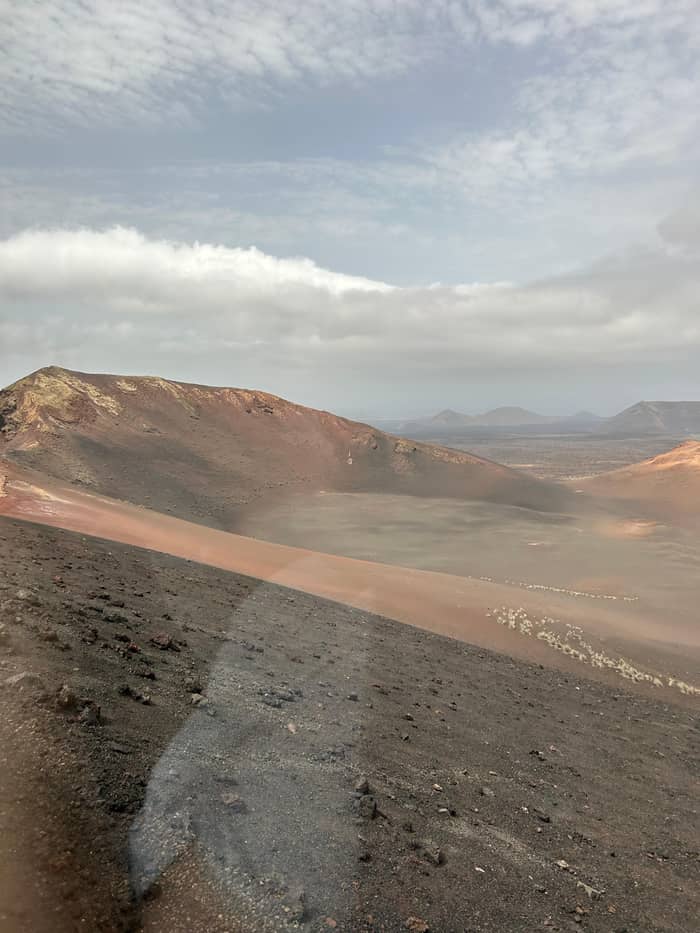
Ignites by itself
The gorse
Fire without a match
See the craters tourGuides
Language
Currency
Find a datefrom €61 · cancelling is freeCost for your party
Brief answer
The geothermal demonstrations at Timanfaya National Park show a gorse shrub igniting in a hot crack and water leaving tubes as steam, with the heat of the subsoil rising to the surface.
The demonstrations in brief
4 options compared
Set your party and compare tours that stop at the islet.
≈
View≈
View≈
View≈
ViewFrom-prices on GetYourGuide, shown at the ECB reference rate. Your exact price is confirmed during booking.
What is shown at the Islote de Hilario: a shrub that bursts into flame, water that comes back as steam and a grill heated by the ground, with the measured temperatures behind each.
Editorial team, timanfayatour.com · Updated November 24, 2026 · Allow 7 min
Facts at a glance
The Timanfaya National Park geothermal demonstrations on the Islote de Hilario are not a stunt. They are a plain way to prove that Timanfaya is still warm underneath. According to the operator, the demonstrations let visitors watch subsoil heat still climbing to the surface, and the ticket page says they reveal temperatures still found a few metres underground.1,4 Whatever you read about the park, the demonstrations are the moment the volcano becomes something you can feel on your face.
The science behind the show is given in the park brochure. It traces the heat to a leftover magma deposit about 4 to 5 km down, which gives readings of up to 610 degrees C at 13 m down and 100 to 200 degrees C at the surface.5 The park's visitor guide agrees on the figure for the deepest probe and adds that anomalies appear mainly on crater rims and in 3 areas: the Islote de Hilario, the Casa de los Camelleros and the bottom of the Timanfaya crater.3,6
The demonstrations are part of the visit, not an extra. The park brochure says admission pays for parking, the geothermal demonstrations and the bus ride along the Volcano Route, which can be taken by bus only.7 The operator's questions page also lists the demonstrations among the things the visit includes, next to the bus tour and the restaurant that cooks with volcanic heat.8 You do not book them separately, and nobody pays on the spot for the show.
The demonstrations
| Demonstration | What happens | Measured heat | Where |
|---|---|---|---|
| The gorse pit | A shrub ignites within seconds2 | 435 °C in the fractures11 | A 3 m excavation11 |
| The geyser tubes | Water leaves as steam2 | 388 °C at 7.5 m14 | Iron tubes about 12 m long18 |
| The restaurant oven | Meat and vegetables are grilled10 | 250 degrees in the well10 | The El Diablo restaurant |
| The side barbecue | Used occasionally as an oven16 | 250 °C16 | A lateral excavation |
| The deepest probe | The highest temperature in the park3 | 610 °C at 13 m3 | Measured in a 13 m borehole |
Temperatures are the park's own measurements in its visitor guide, taken at the depths named, so they describe the ground and not the air.3,11
The first demonstration is the simplest, a fire demonstration that needs no match. A gorse shrub is put into a crack in the ground, and the heat of the area makes it burn spontaneously within a few seconds.2 The park's visitor guide describes the excavation as 3 m deep and says that in the fractures at the bottom of this oven, temperatures of 435 degrees C have been measured.11 The shrub has no chance against numbers like that.
What makes the gesture so striking is how ordinary the ground looks. The surface around the pit is the same dark, dusty ground you see from the coach, and nothing about it warns you. That is the point of the demonstration: the heat is hidden under the surface and shows itself only when something is put into it. The operator warns that parts of the ground are very hot, so visitors must stay in the designated areas and follow staff instructions.12
The gorse is the sort of detail that photographs well, and the operator's list of recommended subjects includes the geyser area.13 Keep a safe distance and let the staff set the pace, since the tour stops at the Islote de Hilario, where the demonstrations take place. A phone held steady will catch the first smoke and the flames.
The heat in numbers
The second demonstration looks like a geyser. In the visitor guide's description, water is poured into tubes that are heated by the ground, and it leaves as steam, an artificial geyser.2 The tubes are made of iron, sealed at the bottom, about 12 m long and 20 cm in diameter, and the guide reports a temperature of 388 degrees C at a depth of 7.5 m in this kind of tube.18,14
There is a good story behind the show. The visitor guide says the idea for the tourist demonstrations came during the building works on the Islote de Hilario, when the drills were cooled with water that came out of the hole as steam, like a geyser.21 The builders noticed it, and the tubes followed. In other words, the geyser you watch is a staged copy of something that happened by accident while the centre was being built.
Stand where the staff direct you, and watch the tubes rather than the ground around your feet. The operator also lists the geyser area among the subjects worth a photograph, so have the phone ready before the pour.13 Wind matters here, since the operator calls the area windy in the cooler season.22 If a gust carries the steam sideways, wait for the next pour rather than moving closer to the tubes.
Your questions
Choose your question and read the plain answer.
If I want to know if they are included
Yes, with the route
The brochure lists the demonstrations in the price of admission.7
If I want to eat on volcanic heat
Plan the El Diablo stop
The restaurant grills over a well at around 250 degrees and takes no reservations.10,20
If I worry about my time on the islet
Go to the demonstrations first
Our listing shows 15 minutes at the Islote de Hilario.
If I want to see more than the show
Read the heat numbers
The deepest measured temperature in the park is 610 degrees C at 13 m.3
If I am going with children
Stay in the marked areas
Parts of the ground are very hot, so staff instructions apply to everybody.12
The spectacles
Ignites by itself
Fire without a match
See the craters tour
Instant steam
Water into steam
See the craters tour
You can taste it
A grill over a well
See the craters tourThe oven stands apart from the other demonstrations, because you can eat from it. At the El Diablo restaurant on the Islote de Hilario, the grill sits above a 5-metre well where the natural temperature of the earth reaches around 250 degrees.10 The visitor guide describes the well as 0.9 m in radius and 5 m deep.19 Temperatures vary a great deal, from 80 degrees C at the bottom to 200 degrees C at the mouth.17
The oven was designed together with the building. The guide says it grew out of a construction that alternates layers of cement, clay ground and rock so that heat flows through the foundations and is led outside through a well.24 A second, smaller excavation at the side is used occasionally as a barbecue oven with a temperature of 250 degrees C.16
A practical note: El Diablo does not accept reservations, and tables are assigned first come, first served, subject to availability at the time of the visit.20 On a coach tour the stop at the islet is short, so decide before you arrive whether you want to eat there or only watch the demonstrations. In the middle of the restaurant a small glazed garden, the Jardín Muerto, pays tribute to the legend of Hilario with the skeleton of a dromedary and a burned tree trunk.25
The visit in order
Arrival
The coaches depart from the islet, where the parking and the restaurant are also found.9
The gorse
Put in a crack in the ground, it burns spontaneously within a few seconds.2
The geyser
Water poured into heated tubes leaves as steam.2
The oven
The restaurant grill sits above a 5-metre well at around 250 degrees.10
On the coach
The visit also includes the Route of the Volcanoes by bus.7
The listing
Our tour shows 15 minutes at the Islote de Hilario.
The figures here come from the park's own documents, and they rank easily. The highest temperature measured in the park is 610 degrees C at a depth of 13 m.3 In the pit where shrubs ignite the fractures reached 435 degrees C, in the iron tubes the probe read 388 degrees C at a depth of 7.5 m and in the side oven the temperature is 250 degrees C.11,14,16 The chart on this page puts them in a row.
Nearer the surface the heat is lower but still strong. On the Islote de Hilario the anomaly covers 3,000 m2 with surface temperatures of 100 degrees C and a maximum of 277 degrees C at a depth of 10 cm.15 At the Casa de los Camelleros the anomaly covers 4,000 m2 in total, with surface temperatures of 60 degrees C and between 150 and 175 degrees C at 10 cm.26 These are the areas where the operator keeps visitors inside marked zones.
The park brochure gives a simpler range for the surface, between 100 and 200 degrees C at surface level, so treat any single number as a sample rather than a rule.5 The point to carry away is that the heat is local, found mainly on crater rims and in a few defined areas, and the rest of the ground is not hot.6
Video
TheKaKaNow on YouTube · Nothing is fetched until you hit play.
On the Islote de Hilario, El Diablo cooks meat and vegetables with heat rising from the subsoil.
Checklist
On our craters tour, the demonstrations come at the Islote de Hilario. The listing gives roughly an hour of guided coach time in the park followed by a 15-minute visit to the islet, and it names the geothermal demonstrations there. That is a short window for the gorse, the geyser and a photograph, so go straight to where the guide is working rather than to the shop.
The price of our tour starts from €61, and a full refund is offered when you cancel a day ahead, which helps if the weather or the schedule changes. The listing names the Interpretation Centre as the stop that replaces the park when it is closed, and that day would have no demonstration at all. Reviewers asked for more time at the islet, so a quick plan helps.
If you want the demonstrations without the coach, buy your own slot on the operator's site, since tickets are sold online only and for a chosen time.23 The small-group Insólita Experience is a separate product from the regular route.27 For most first visits, a coach tour with pickup is the easiest way to see the gorse and the geyser demonstration in a single, simple outing.
FAQ
The brochure says admission includes parking, the geothermal demonstrations and the Volcano Route by bus.7
The restaurant does not accept reservations, and tables are given first come, first served.20
Drills cooled with water produced steam like a geyser during the building works, and the tubes followed.21
Parts of the ground are very hot, so visitors stay in the designated areas and follow staff instructions.12
The listing for our tour gives 15 minutes at the Islote de Hilario.
Sources
Planning a Timanfaya tour? Ask a real person here.