The standard way
The regular coach
The ticket route
See the craters tourGuides
Language
Currency
Find a datefrom €61 · cancelling is freeFind a stop on the map
Brief answer
The Timanfaya volcano road is a regulated coach route of around 14 km, taken by coach from the Islote de Hilario because free exploring by car or on foot is not permitted.
The volcano road in brief
View 11 stops
Tap a route first, then a pin or stop, for its note and Google Maps.
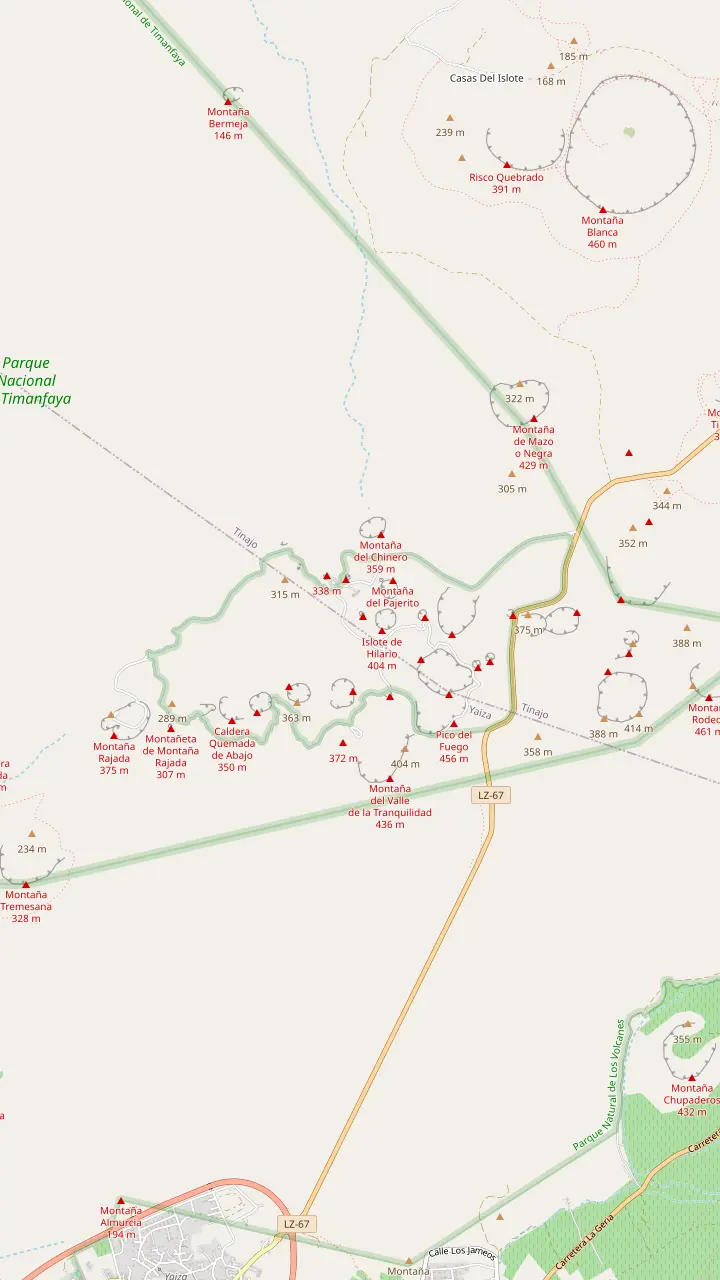
El Taro is the entrance checkpoint, and from here to the Islote de Hilario visitors must stay inside their vehicle.
Google MapsThe Islote de Hilario is where the coaches of the Route of the Volcanoes depart, with the parking, the El Diablo restaurant and the geothermal demonstrations.
Google MapsThe Valle de la Tranquilidad takes its name from the Moon's Sea of Tranquility and is covered in warm ash.
Google MapsMontana de Timanfaya is one of the emblematic cones of the park, also called the Montana del Fuego, and its geothermal anomalies can reach 250 degrees.
Google MapsMontana Rajada has two almost concentric craters, and the small-group Insolita experience has exclusive access to it.
Google MapsThe Caldera del Corazoncillo has a deep crater whose base lies 33 m below the lava field around it, and the park brochure counts it among the most emblematic cones.
Google Maps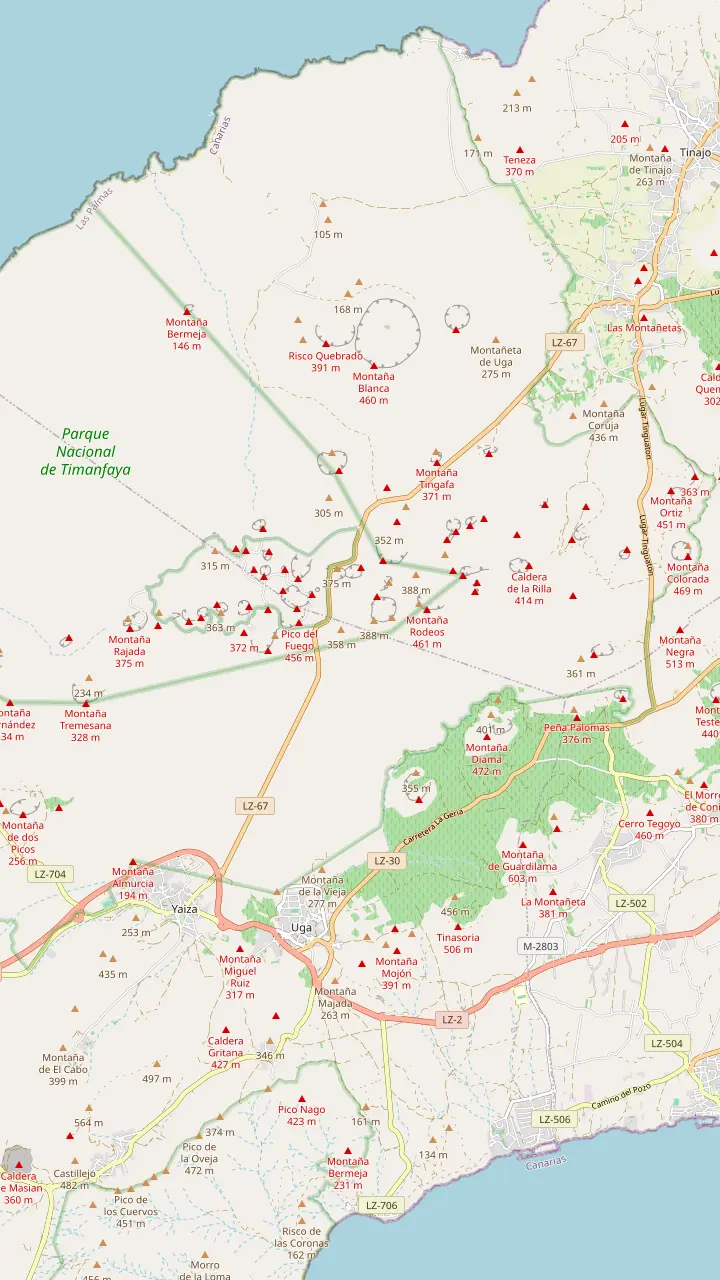
Yaiza is the village on the southern approach, from which the road climbs towards the Echadero de los Camellos.
Google MapsThe Echadero de los Camellos is where the camel rides leave and where a small museum stands, about 2.5 km before the El Taro entrance.
Google MapsEl Taro is the entrance checkpoint, and from here to the Islote de Hilario visitors must stay inside their vehicle.
Google MapsThe Islote de Hilario is where the coaches of the Route of the Volcanoes depart, with the parking, the El Diablo restaurant and the geothermal demonstrations.
Google MapsThe Mancha Blanca Visitor Centre gives an overview of the park in several languages, free of charge.
Google MapsMap data from © OpenStreetMap contributors
The regulated coach road through the fire mountains, taken stop by stop: the checkpoint, the departures, the craters, the quiet valley, with a map and a table of what each place shows.
Editorial team, timanfayatour.com · Updated November 24, 2026 · Allow 7 min
Facts at a glance
The Timanfaya National Park volcano road in Lanzarote is not a public road you can add to a rental-car day. It is a regulated road inside the park, and the operator is clear that visitors may not roam the park by car or on foot, since the ecosystem is fragile.2 What you do instead is board a coach for the Route of the Volcanoes, which stretches around 14 km across the heart of the eruption zone.1 The Lanzarote road, in other words, is something you ride and watch rather than drive.
The route was conceived by the artist César Manrique, and the coach is specially equipped to let passengers observe caves, craters, lava blankets and the lava fields known as malpaís.1,5 The word malpaís is worth keeping in mind, since it names the rough, harsh lava surface that cannot be crossed on foot. The park authority describes the viscous kind of lava as forming a surface that is rough, harsh and impassable.6 That is exactly why a road was cut through it, and why nobody is allowed to wander off it.
The same logic runs through the rules. The park brochure forbids walking on lava beds or on any kind of volcanic material, and the ticket page tells passengers they may not leave the bus during the tour.7,4 Read the volcano road as a moving viewpoint and the restrictions make sense: the landscape stays untouched while visitors still see it.
Stop by stop
| Stop | What you see | What the operator says | Mind this |
|---|---|---|---|
| El Taro | The entrance checkpoint | Nobody leaves the vehicle between here and the islet10 | No stepping out |
| Islote de Hilario | The sea of lava and the departures | More than 25 craters close together17 | Parking is here11 |
| Sea of craters | Red, black and ochre slopes | A landscape of textures and colours18 | Photograph through the glass |
| Halfway view | The turn between volcanoes | A 180-degree turn, then a return between volcanoes19 | Name the cones from the map |
| Valle de la Tranquilidad | Warm ash and calm | Named after the Sea of Tranquility, covered in warm ash20 | The ground is warm |
| Back at the islet | Demonstrations and the oven | Geothermal demonstrations show heat still rising21 | Stay in the marked areas22 |
The stops follow the order of the visit, and the descriptions restate the operator's own pages.12,17
Every visit begins with a ticket, and the ticket is bought online. The operator keeps no box office for sales, so the Timanfaya National Park volcano route begins at a screen, not at a kiosk.8 The booking asks you to choose a visit time and to reach the ticket office 15 minutes ahead of it.9 Our own tour handles this for you, but anyone who plans to arrive in a rental car needs the slot first.
On the day, the road to the park passes the El Taro entrance, and past that gate nobody leaves their car until the Islote de Hilario.10 The Islote de Hilario is the working heart of the visit: the coaches of the Route of the Volcanoes depart from it, and so do the parking and the El Diablo restaurant.11 The park brochure adds that admission covers parking, the demonstrations and the Volcano Route, taken by bus only.14
Departures are frequent. Coaches go out at 20-minute intervals, and the questions page puts the ride at approximately 40 minutes.3 The ticket page and the visitor guide give a slightly different figure for the route itself, approximately 35 minutes, and the full visit comes to approximately 1 hour and 15 minutes by the visitor guide.12,15 Treat the figures as a range: the ride is a little over half an hour, and the whole stop is an hour or more once the demonstrations are counted.
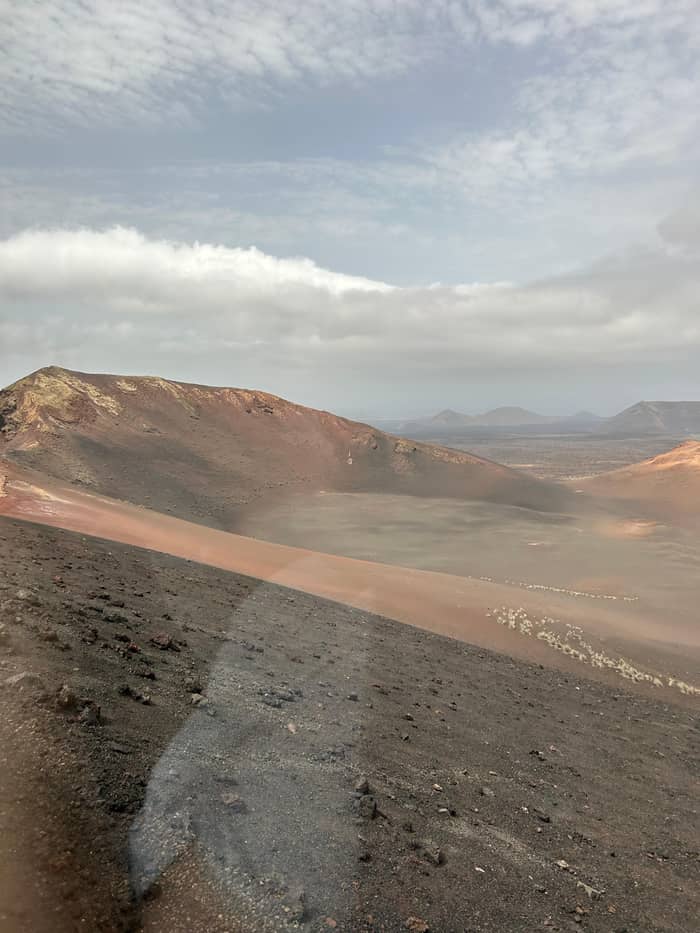
What the coach drives through is lava country, with more than 25 craters crowded into a few square kilometres, as the operator puts it, and you first see it from the Islote de Hilario itself.17 The colors stand out first: the operator's palette for the craters is red, black and ochre, set in a landscape of textures.18 On the approach road, the sculpture of the Devil of Timanfaya, a symbol of the national park, is the figure that welcomes visitors.27
Halfway along the route the road makes a turn that the operator describes as 180 degrees, and the return runs between a pair of volcanoes.19 From that stretch the views open to Montaña Rajada, Montaña Termesana, Montaña de la Vieja Gabriela, Pico Redondo, Montaña de Dos Picos and Montaña de la Mancha, with Montaña de Enmedio and Montaña de la Cinta in the distance.19 It is the stretch where a map is most useful, and the maps above place the named cones around the road.
The quiet part is the Valle de la Tranquilidad. The valley borrows its name from the lunar Sea of Tranquility, the landing site of Apollo 11, and the operator describes the valley as covered in warm ash and one of the calmest scenes on the route.20 After the red and black of the craters, the pale ash makes the pause feel real. The ground in the valley is quiet, but the ash is not cold.
Which way in
Pick your priority for the ride and read a plain answer.
If I want to drive through the park myself
Not possible
Roaming by car or on foot is not allowed, and the coach route is the way in.2
If My legs are not good on stairs or slopes
Ask for the adapted coach
The operator states that the Route of the Volcanoes has adapted coaches.25
If I want to climb a cone
Book the small-group visit
The small-group visit reaches a cone and a refuge that the regular route does not.23
If I want a short walk with a guide
Try the Termesana route
It is a guided walking tour of about 2 km, booked at the Mancha Blanca Visitor Centre.26
If I want pickup and no driving
Choose the tour with pickup
Our craters tour picks up from 53 points and lists guides in English, Spanish and French.
Ways onto the road
The standard way
The ticket route
See the craters tour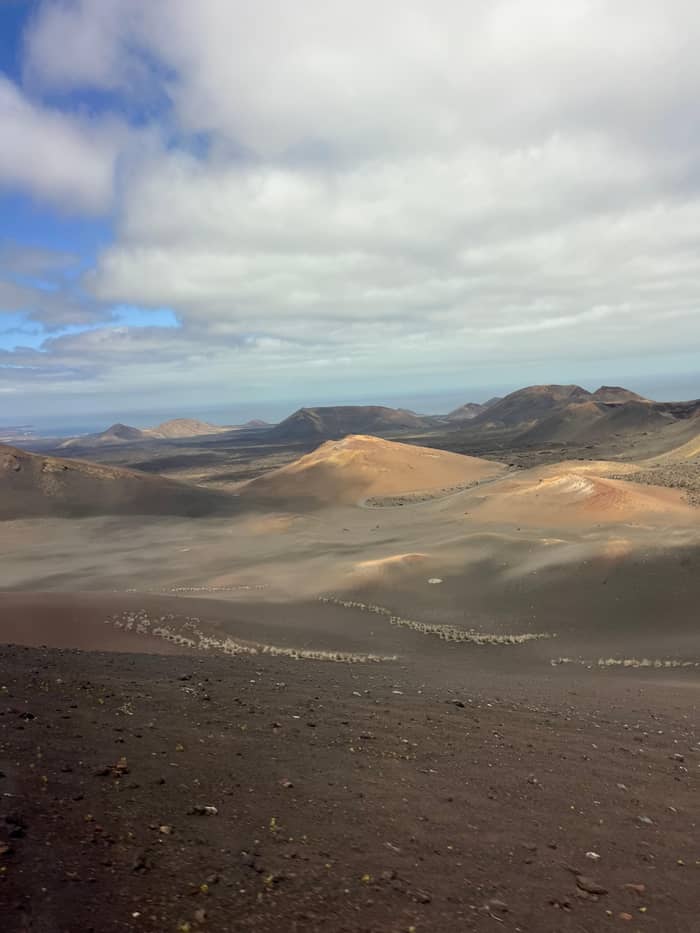
Guided and small
Insólita Experience
See the craters tour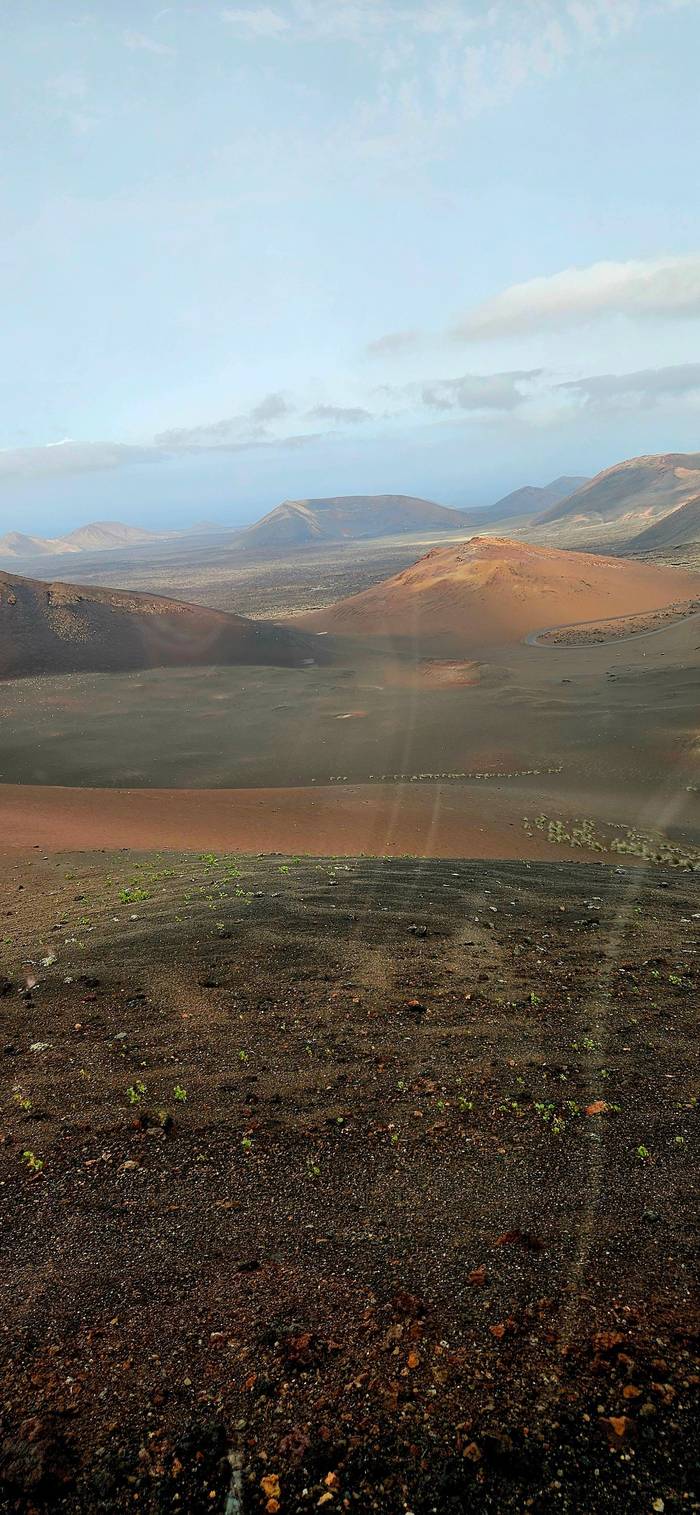
Pickup included
Pickup and coach
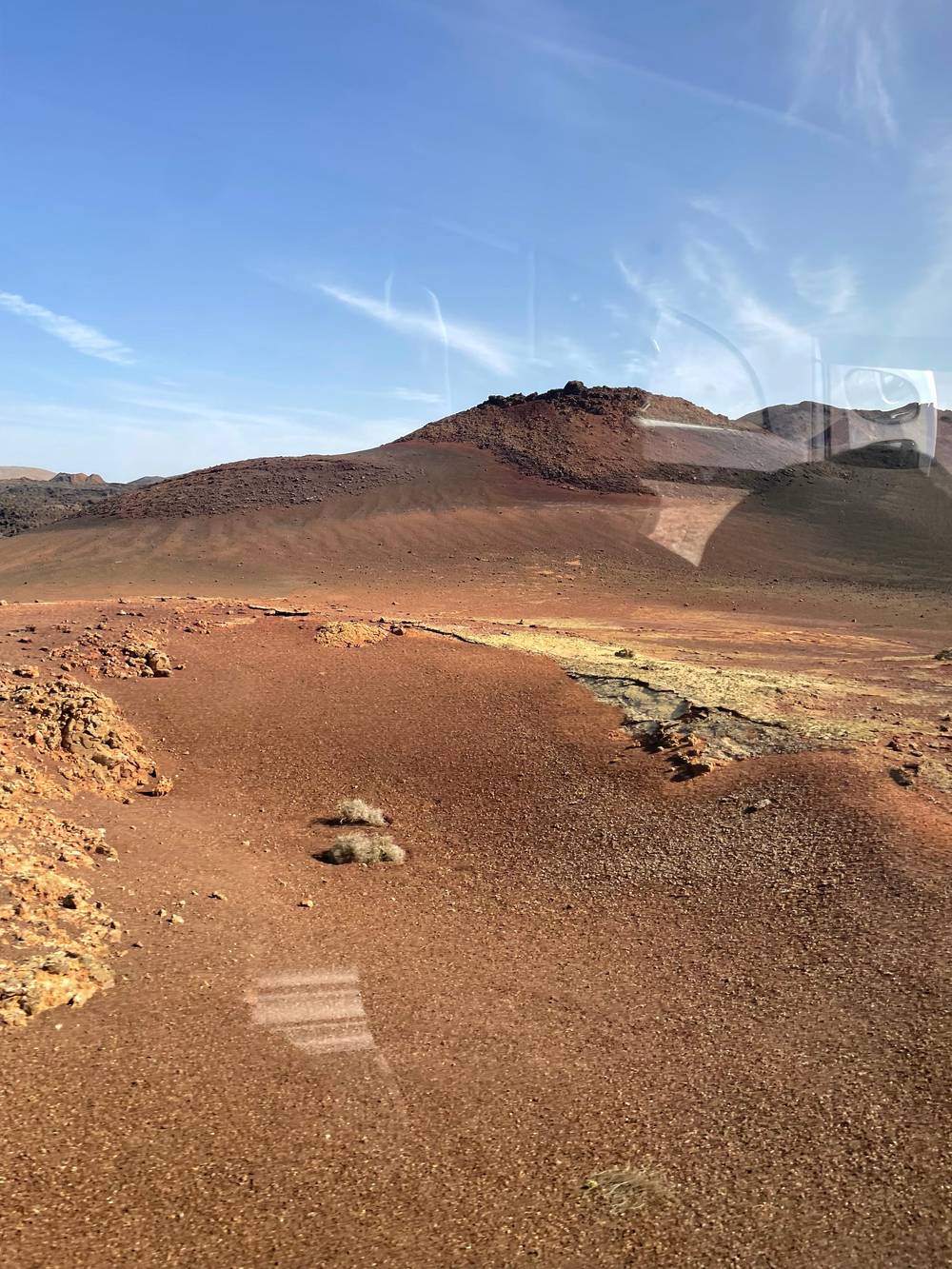
Search for the Timanfaya National Park luna route and you will land on this same coach road, because the operator itself describes the park as craters, lava flows and lunar-like landscapes that reflect the heat of the earth.37 There is no separate moon route to book: the lunar look comes from the lava, the ash and the lack of vegetation, and the coach drives through each of them on the Route of the Volcanoes.1
The comparison is not only a figure of speech. The operator adds that astronauts have trained on this ground, because its geology was chosen as part of the preparation for planetary expeditions.38 The park brochure says the landscape has no tree life at all, a feature it counts among the most striking aspects, and it tallies close to 200 taxa of lichens on the lavas.39,40 Bare ground, bright patches of lichen and the red of the cones make a combination that is easy to recognise from the window.
For the eye, the contrast is the thing to look for. Lapilli, the airborne fragments between 2 and 20 mm in size, give the slopes their loose, gritty look, and the park authority notes that farmers use them for their hygroscopic properties.41 On the coach you are looking at the same material from a distance, and the audio narrative helps you read what it is.
Plan the day
Set your party and compare ways to ride the road.
4 options compared
Set your party and compare ways to ride the road.
≈
View≈
View≈
View≈
ViewFrom-prices on GetYourGuide, shown at the ECB reference rate. Your exact price is confirmed during booking.
The visit in order
Online booking
Tickets are sold online only, for a chosen visit time.8
At the office
The operator asks visitors to be at the ticket office 15 minutes before the booked time.9
El Taro
From the entrance to the Islote de Hilario nobody may step out.10
Islote de Hilario
The buses depart from here, where parking and the restaurant are also found.11
On the route
The ride covers around 14 km, with the turn and the quiet valley.1,12,3
Back at the islet
The visit also includes the geothermal demonstrations and the viewpoint.13
An audio narrative runs through the visit and points out the shapes the eruptions left behind.42 The operator gives the languages in slightly different ways: the ticket text speaks of a route guided in Spanish, English and German, and the questions page of an audio guide in Spanish and English.43,44 The listing for our tour names live guides in English, Spanish and French. Check the language you need against the booking you make, and treat the commentary as the guide to what the windows show.
For pictures, the operator's shortlist is the geyser area, the oven that cooks on volcanic heat, the Devil sculpture and the route itself.45 Since passengers cannot step out during the ride, you will shoot through the window, so a phone held flat to the glass works better than a long lens. If you want a shot without a window, the Islote de Hilario is the place, where the visit includes the viewpoint over the volcanic landscape and the demonstrations.21
Mobility is covered: the operator states that the Route of the Volcanoes has adapted coaches.25 For clothing, the operator advises comfortable footwear, sun cover in the warm months and a warm layer in the cool, windy ones.46,35,36 The listing for our tour flags uneven, rough or slippery ground and suggests trainers that cover the toes.
Video
Vmondude on YouTube · Nothing is fetched until you hit play.
César Manrique conceived the Route of the Volcanoes, a route of around 14 kilometres through the main core of the eruptions.
Checklist
Our site sells a coach tour with pickup from 53 hotel and bus-stop points around the island, and the listing shows 5 hours, stretching or shrinking between 4 and 6 hours by pickup point. Inside that time, the listing shows about 1 hour on a guided bus tour in the park, then 15 minutes at the Islote de Hilario. That is longer than the operator's route time, and it is worth knowing before you plan the afternoon.
The listing names the geothermal demonstrations at that stop, and it says the Timanfaya Interpretation Centre replaces the park if the park is closed. The price starts from €61, and a cancellation made at least a day ahead is refunded in full. Several recent English reviewers would have liked longer at each stop, so use the time at the Islote de Hilario well.
If you would rather see the road on foot, the park authority offers a guided walk of about 2 km, the Termesana route, booked at the Mancha Blanca Visitor Centre.26 The small-group Insólita Experience goes further than the regular coach, with exclusive guided access to Montaña Rajada and the Refugio de Tinecheide.23 It starts at 08:45 and runs on Mondays, Wednesdays and Saturdays.24 For most first visits, though, the coach is the simplest way to see the road, and the maps above show where it goes.
FAQ
The Route of the Volcanoes stretches around 14 km across the heart of the eruption zone.1
Passengers remain on the coach for the whole route, so photographs are taken through the window.4
The operator states that the Route of the Volcanoes has adapted coaches.25
The operator sells tickets online only, with none at the box office.8
The operator describes the park as lunar-like landscapes, and the coach route is the way to see them.37
Sources
Planning a Timanfaya tour? Ask a real person here.